google-vertex · tool-assisted
gemini-3.8-flash
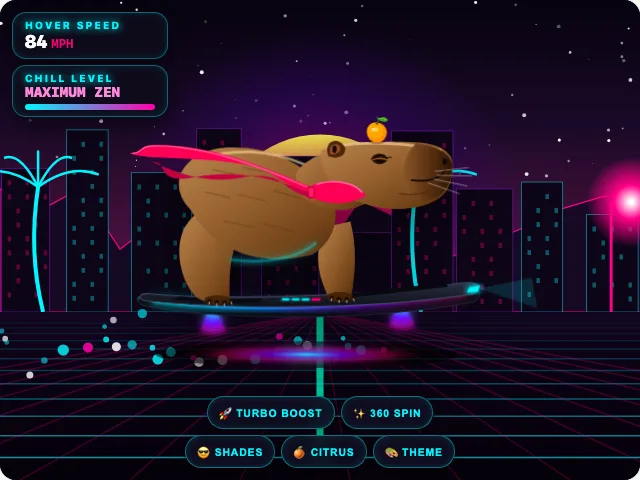
Rendered output
Preview is stopped. Starting it executes generated code.
Preview safety and restrictions
Restricted preview policy restricted-html-v1. A blank result is not an automatic pass or failure. Restrictions may affect the output.
Generated scripts can consume CPU or navigate their own frame. Curator review is required. Stop cannot reliably recover a blocked browser.
Curator's read
What stands out
A detailed read of this attempt's approach, distinctive choices, and lessons for future runs.
- This high-effort Pi run used Gemini 3.8 Flash through Google Vertex and produced a 42.9 KB self-contained HTML response in 16 minutes 20 seconds, with 5.46M recorded total tokens.
- The most effective design choice was splitting responsibilities: inline SVG gives the capybara and hoverboard precise character detail, while Canvas drives the procedural neon city, parallax road, stars, and particles.
- The final scene combines pointer and keyboard steering, hover physics, head bobbing, blinking, scarf motion, particles, boost, a 360 spin, shades, citrus, and theme switching while remaining dependency-free.
- The run used an iterative visual QA loop with repeated browser previews, several intermediate prototypes, a syntax check that caught a duplicate waveFreq declaration, and cleanup of temporary files.
- Compared with pi-01a12625, the artifact grew from 41.4 KB to 42.9 KB, recorded work increased from 2.16M to 5.46M tokens, and the interface gained a 360 spin and citrus control.
- Compared with pi-01a12905, this version is smaller and simpler: 42.9 KB versus 46.8 KB and 5.46M versus 7.07M tokens. The later run adds more controls and state, while this one keeps a more compact interaction set.
- The main takeaway for future runs is to keep the SVG plus Canvas architecture and screenshot-driven workflow, while seeding procedural randomness, adding interaction smoke tests, and resolving the S-key conflict between steering and shades.
Inspect the evidence
Challenge and protocol ↗The curator reports this collected series is fully published.
Exact user instructions
User turn 1
Build an animated capybara riding a hoverboard using only HTML, CSS, and JavaScript.

Deliver a single self-contained HTML file with all CSS and JavaScript inline. Do not use external libraries, external image assets, external fonts, or network requests. Inline SVG, CSS drawing, and canvas are allowed.

The result should visibly show a capybara riding a hoverboard, with animation that makes the scene feel alive. Do not include audio.

Return only the HTML source, without explanations or Markdown code fences.
Run provenance
Capture conditions
{
  "path": "thumbnails/pi-01a128ec-d942-7211-ac9e-19e0b5634a43.webp",
  "viewport": {
    "width": 640,
    "height": 480
  },
  "capture_delay_ms": 1000,
  "browser_version": "156.0.8078.4",
  "preview_policy_version": "restricted-html-v1"
}
The curator's read above contains observations, not scores. Null capture metadata means unknown.
Original response
Expand to retrieve the preserved artifact.
Extracted HTML
Expand to retrieve the preserved artifact.